Kies je regio

Selecteer de regio die het beste past bij je locatie of voorkeuren.

Kies je sitetaal

Deze instelling regelt de taal van de gebruikersinterface, inclusief knoppen, menu's en alle tekst op de site. Selecteer je voorkeurstaal voor de beste browse-ervaring.

Kies de talen voor vacatures

Selecteer de talen voor vacatures die je wilt zien. Deze instelling bepaalt welke vacatures aan jou worden getoond.
International Max Planck Research School IMPRS for Molecular Plant Science

International Max Planck Research School IMPRS for Molecular Plant Science

Website bezoeken

Over de werkgever

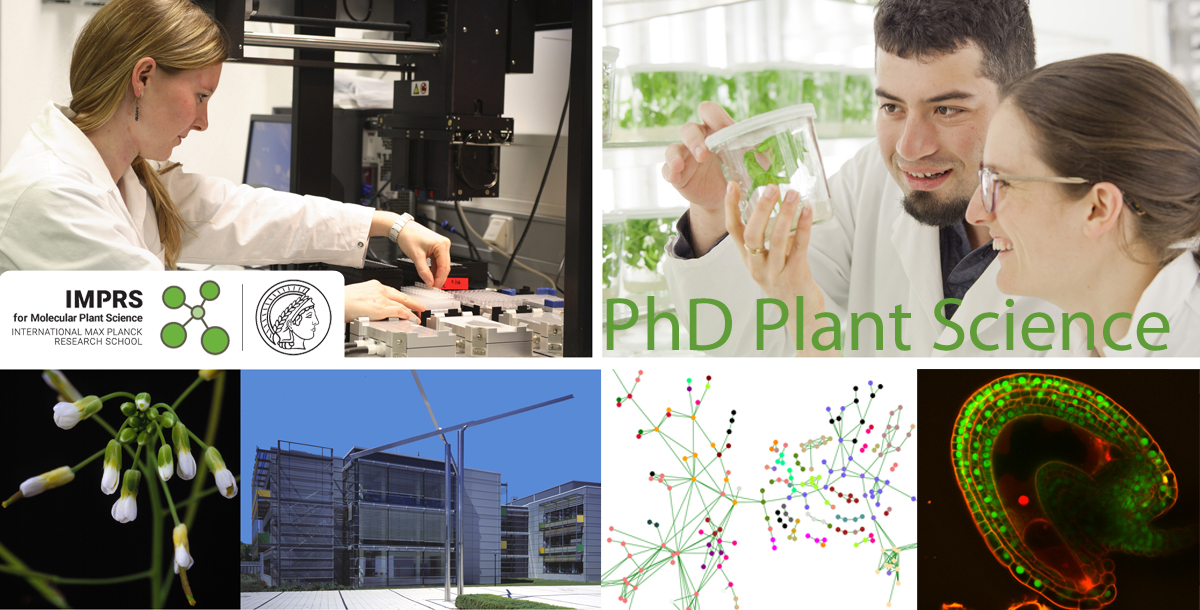
The IMPRS for Molecular Plant Science (IMPRS MolPlant) is a joint initiative of the University of Potsdam and the Max Planck Institute of Molecular Plant Physiology, located in Potsdam near Berlin, Germany. The doctoral program was established in 2007. We are accepting talented graduate students into the IMPRS at regular intervals. Our graduate students conduct their research projects under the supervision of our faculty members.

Research Focus

Research in modern plant science is at the core of the IMPRS. Plants and their seeds, for example rice, wheat, maize and pulses, are vital for human nutrition. Understanding the fundamental processes of how plants grow, reproduce and interact with the abiotic and biotic environment is of great scientific interest and, ultimately, has societal and economic implications. 

We conduct curiosity-driven, basic research centering around the following questions:

  • How do primary physiological processes such as photosynthesis, central metabolism and respiration function, and how are their activities regulated?
  • How do plants form their organs, tissues, cells and sub-cellular structures, and how is the formation of different organs and structures coordinated? 
  • How is epigenetic information established and transmitted and how do epigenetic processes impact on plant development?
  • How do plants and soil fungi interact to establish arbuscular mycorrhiza (AM) symbiosis, and how are the accommodation of AM fungi inside root cells and the plant’s physiological and developmental state interconnected?
  • How do exogenous, environmental factors such as light, temperature, and availability of water and nutrients influence plant physiology, development and the interaction with microorganisms?
  • How are exogenous and endogenous signals perceived, and how is information transmitted and integrated to ensure plant health, survival, biomass acquisition and seed formation?
  • How can we manage, analyse and integrate complex, large-scale genomic, epigenomic, transcriptomic, translatomic, proteomic and metabolomic datasets to answer biological questions and generate new hypotheses?

To answer these questions, we use an interdisciplinary approach combining molecular biology, genetics, genomics, epigenomics, metabolomics, biochemistry, biophysics and microscopy with bioinformatics and modelling. We work with Arabidopsis thaliana, tobacco, tomato, Lotus japonicus, rice and other model plants, and make use of genetic diversity by studying natural accessions, closely related species, and introgression populations. 

Website of the IMPRS: https://www.mpimp-golm.mpg.de/IMPRS-PhD 

Locatie werkgever

Vergelijkbare werkgevers

Dit vind je misschien ook interessant

Why KTH Is the Ideal Place to Shape the Future Through Your Work
Why KTH Is the Ideal Place to Shape the Future Through Your Work KTH Royal Institute of Technology Leestijd: 5 min
Bringing Society’s Voice into Science
Bringing Society’s Voice into Science University of Oulu Leestijd: 5 min
Bringing Artificial Intelligence Into the Real World
Bringing Artificial Intelligence Into the Real World Mohamed bin Zayed University of Artificial Intelligence (MBZUAI) Leestijd: 4 min
Connecting the Dots With Life Course Epidemiology
Connecting the Dots With Life Course Epidemiology University of Oulu Leestijd: 4 min
Meer stories

Vergelijkbare vacatures